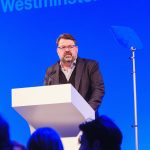
A very good afternoon to you all.
Welcome to the Westminster Property Association’s 38th annual lunch.
It’s a privilege to bring together those who help shape Westminster.
I’m pleased to welcome George Osborne as our keynote speaker.
As Chancellor, and through his work in business, media, culture and technology, George has seen Britain’s economic choices from many perspectives, and I am looking forward to his reflections.
Not least, how we fund public services. How we deliver growth. How we adapt to a world changing at extraordinary speed.
And I want to start by celebrating the role our industry already plays in meeting those challenges.
WPA members own forty per cent of Westminster’s commercial floorspace. And the businesses operating in their buildings support 335,000 jobs and forty two billion pounds of economic activity each year.
Those are extraordinary numbers. And as you have just seen, behind them are real people and real places.
At Soho Place, investment alongside the Elizabeth line has delivered new workplaces, a theatre and a public square.
At Ebury Bridge, regeneration is delivering council homes and new opportunities. Fabiola Umar, who I spoke about last year, has progressed from a work placement into a project management apprenticeship.
And the impact extends well beyond individual developments.
Over five years, WPA members generate CIL and Section 106 contributions equivalent to the capital cost of around forty GP and health centres.
These are the wider benefits that development makes possible.
We don’t just create buildings. We create places in which people and businesses can succeed.
And we should be proud of that.
But as we are all aware, the UK, like many other countries, is facing difficult decisions about how to achieve meaningful growth.
These decisions mean trade-offs. And trade-offs have consequences, some much easier to see than others.
London’s skyline tells that story.
Every building has something to say about investment, ambition, controversy and compromise.
We know buildings we admire and others we regret, those that changed a neighbourhood for better or worse.
But there is another category we almost never talk about.
The building that doesn’t exist.
The invisible building.
An office that never made it beyond the drawing board.
A building that might have brought an international business to London, created jobs and breathed new life into a neighbourhood.
But after years of planning, negotiation and rising costs, the investment stopped making sense.
And so it was never built.
It’s easy to overlook a building that doesn’t exist.
It casts no shadow. It doesn’t change the skyline. Nobody writes to their councillor to complain about it.
But think about what else we cannot see.
The construction site opening in Paris instead.
The job adverts appearing in Singapore.
The young Londoner whose first job never materialised.
The coffee never bought on the way to work.
The lunchtime trade that never reached the sandwich shop.
The people who aren’t vertically drinking in a Westminster pub on a Thursday evening.
Those small moments add up.
People working in WPA members’ buildings spend around one billion pounds annually in Westminster’s shops, cafés and other businesses.
That spending sustains livelihoods and keeps streets alive.
And when investment doesn’t happen, we need to consider what might be lost.
The costs are harder to measure. They don’t generate objections. They rarely make headlines.
But doing nothing is not the same as having no impact.
Of course, we must examine the effects of development on our heritage, environment, streets and communities.
But we should be equally serious about the consequences when worthwhile development doesn’t happen.
We have quite reasonably asked more of development: higher environmental standards, better public spaces, more affordable accommodation and greater contributions to communities.
All important ambitions.
But the more value we seek from development, the more we risk making the development itself unviable.
This is the planning paradox.
We cannot see the invisible building. But we all pay the price for it.
Our shared challenge is to make those opportunities real.
That means clear expectations from the outset. Early agreement on what each scheme can realistically deliver. And timely decisions that keep worthwhile investment moving.
Which is why the council’s explicit focus on growth is so welcome, as are the tangible steps it has already taken to put this into practice.
Its Growth Statement recognises that Westminster needs high-quality workplaces to attract investment and remain competitive.
And its commitment to a “towards yes” approach, alongside work on a new pro-growth City Plan, gives that ambition real direction.
We strongly support that approach. Together, we are exploring how we can better demonstrate what good development delivers for Westminster’s communities.
The creativity, confidence and capital in this room can help turn these commitments into a platform for prosperity.
And we start from a position of strength.
Despite the headwinds we have faced, London remains the European destination of choice for new business headquarters, attracting three times as many HQs as any other European city.
Our goal at the WPA is to work in partnership with the council and the new Oxford Street Development Corporation to secure Westminster’s long-term prosperity.
We know what successful partnership can achieve.
Better streets for residents, workers and visitors. Investment that improves places as well as buildings.
And the benefits go far beyond Westminster.
Look closely at the West End and you can see the whole country reflected back at you.
Portland stone from the Jurassic Coast in our buildings.
Wool from Huddersfield mills on Savile Row.
Trains built in Derby carrying passengers on the Elizabeth line.
Sheffield cutlery on the tables of our hotels and restaurants.
Jobs. Skills. Orders. Investment.
Livelihoods hundreds of miles away, supported by the success of a few streets in central London.
Enabling growth here isn’t about asking government to choose London over the rest of the country.
It’s about what London can do for the rest of the country.
Prosperity also means making sure the next generation has the opportunity to share in it.
That is why we are taking direct action.
Today, I can announce that the WPA is creating a new Westminster Employability Grants Fund.
Administered by the Young Westminster Foundation, the Fund will provide one hundred thousand pounds over the next two years to help people in Westminster access careers advice, training and employment opportunities in our sector.
We want more people to follow Fabiola’s path, from an introduction to our industry to the beginnings of a career within it.
That same spirit of collaboration underpins so much of our work.
None of it would be possible without our partners at Westminster City Council, the OSDC, the GLA, central government, neighbouring boroughs and the many other organisations and individuals we work with.
I want to take this opportunity to thank the Board, including my Vice Chair Dan Nicholson, for their support, and the WPA executive team, led by Charles Begley.
Let’s make sure the next chapter in London’s skyline is one of opportunity and growth.
And let’s make sure its benefits are felt not just in Westminster, but across London and across the country.
I hope you enjoy your lunch and have a wonderful afternoon.